
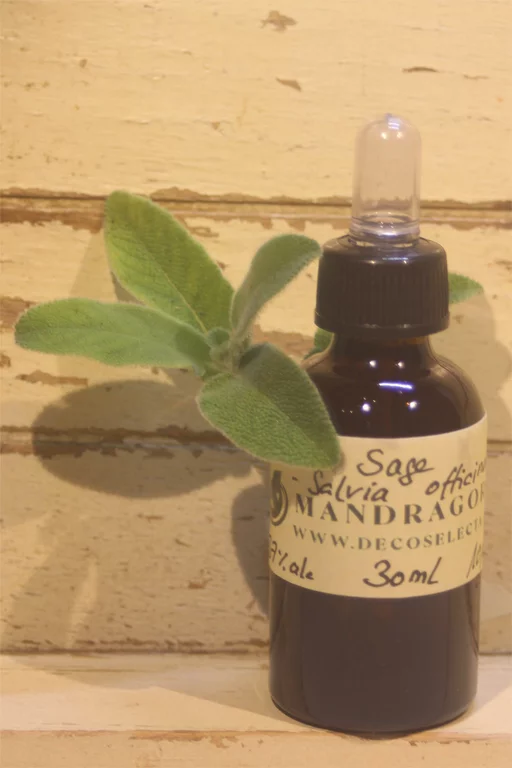

Sage is a
symbol – of purity, warmth, wisdom, and
constancy.
It can add depth to dishes,
clear spaces, support rituals, or be soothing as a tea. It is
versatile yet true to its character: aromatic, clear, and
powerful.

No.60
Effects & benefits
Antihidrotic (reduces sweating): Sage has traditionally been used to help with excessive or night sweating.
Antimicrobial / anti-inflammatory: Its constituents act against bacteria and microorganisms and have supportive effects in inflammation, especially in the mouth and throat area.
Digestive & antispasmodic: Sage may help with bloating, a feeling of fullness, or digestive discomfort.
Support of cognitive functions: Initial indications suggest that sage may have positive effects on memory and concentration.
Constituents of sage
Thujone
Camphor
1,8-cineole (eucalyptol)
Borneol
Limonene
α- and β-pinene
Rosmarinic acid
Caffeic acid
Chlorogenic acid
Salvin
Carnosic acid
Carnosol
Flavonoids (e.g. luteolin, apigenin, kaempferol)
Bitter compounds
Tannins
Resins
Saponins
Vitamins (especially vitamin K; trace amounts of vitamins A & C)
Minerals (e.g. calcium, magnesium, potassium – in small amounts)
Use
Internal: Take a few drops of the tincture in water or juice. One manufacturer, for example, recommends for adults approx. 1.5–2 ml (45–60 drops) 3× daily.
External: Can be used diluted on skin or mucous membranes, or as a mouthwash/gargle (see below).
Traditional uses: Excessive sweating, digestive complaints, inflammation of the mouth/throat, hormonal complaints.
The external use of a sage tincture is possible and can be useful in certain cases:
Mouth/throat rinse or gargle: Diluted tincture as a gargling solution for inflammation or irritation of the oral cavity, throat, or gums.
Skin/mucous membranes: Use with diluted tincture for certain skin or mucosal issues (e.g. mild inflammation).
Pregnancy & breastfeeding: Sage tinctures—especially highly concentrated extracts—should not be used during pregnancy or breastfeeding without consultation.
Epilepsy or seizure disorders: Due to the thujone content, caution may be required in cases of epilepsy or seizure tendency.
Skin tolerance: For external use, test first on a small area (patch test).
Sage is a plant that has
accompanied people for thousands of years—in the kitchen, in
ancient rituals, in monastery gardens, and in folk tradition.
Its scent is unmistakable: warm, herbal, bitter, and at the
same time clarifying. It feels as though it opens a space and
orders the thoughts.
Its Latin name
Salvia is derived from salvare—to heal, to
preserve, to save.
Hardly any plant is as
closely associated with protection, purity, and wisdom as
sage.
What sage stands for
Purification –
traditionally used in incense to cleanse spaces
Wisdom –
sage was regarded as a herb of insight
Strength –
its robust leaves and spicy aroma symbolize power
Constancy –
a plant valued for centuries
The nature of sage
Sage feels like a plant that
“carries knowledge within it”:
It grows in the sun, stores
warmth, has a strong fragrance, and appears almost majestic in
its presence.
The silvery-green, velvety
leaves are calming and visually like a promise of peace and
clarity.
In the kitchen
It gives dishes
depth—whether gnocchi tossed in butter, herb bread,
Mediterranean sauces, or tea.
Often just a hint of sage is
enough to transform an entire dish.
As incense

Above all, to eat a healthy diet, engage in sports, enjoy daily
movement outdoors in nature, and drink clean water. However, in
today’s world it is often not possible to follow all of these
essential principles of life regularly or long-term. In
addition, stress levels are widely high, and exposure to
environmental factors, chemicals, toxins, pesticides, and much
more has increased.
An essence from the wonderful natural world can not only
provide us with valuable vitamins, minerals, and feelings of
happiness: when used correctly, it offers remarkably efficient,
side-effect free support, both preventively and reactively. ✔️
